
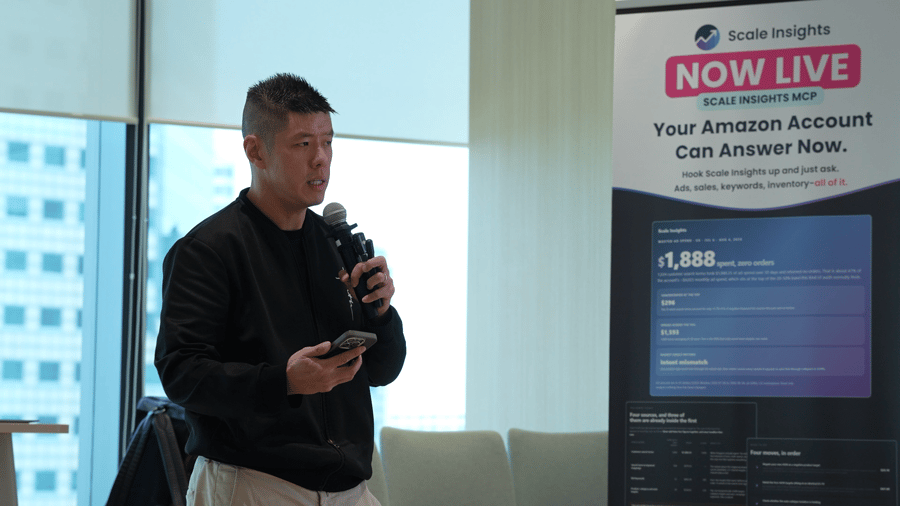
Recently at AI Scaling Live, I got to do something I don't get to do enough in my role: meet one of our customers face to face and sit in a room while he walked us through how he actually works.
Most of the time, working within the Customer team, I see the data, the conversations, the support tickets and the outcomes. I don't always get to see the thinking behind them. I know what customers do in the product, but I don't always get to sit beside them while they explain why they do it, which is arguably where the more interesting part is.
Kevan had put an AI agent to work on his own Amazon PPC, using real products and real money, and he came to the event with the workflow and the numbers to show us what happened. More interestingly, he showed us the things it found that he hadn't spotted himself.
We thought it was too good to leave inside one conference room, so we asked Kevan if we could share it with our community. Thankfully, he said yes.
Kevan is an 8-figure, multi-brand Amazon seller, and his take on how most people work with PPC data is fairly blunt: the old process is broken. A search-term report is basically a list of strings, and reconciling reports by hand is exactly where the expensive mistakes hide. Before the Scale Insights MCP, every figure in his deck meant downloading reports and pulling them apart manually. Now the agent does the reading, which, frankly, sounds like a much better use of an AI than asking it to write your LinkedIn posts.
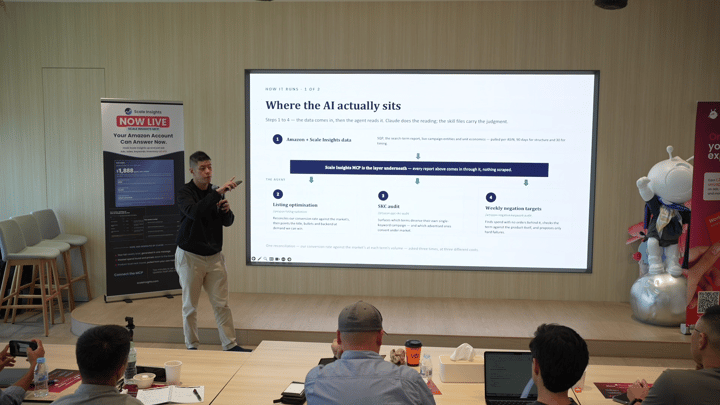
His setup is three repeatable jobs, all working from the same two reports, with everything pulled straight from the live account through the Scale Insights MCP. One points his listing at demand he can actually win. One turns the terms he already beats the market on into candidates for their own campaigns. One sweeps weekly for spend with nothing useful to show for it.
The agent reads and proposes. Kevan approves every change, row by row. The parts that write back to Amazon, including building the campaigns, are handled through his own setup. So no, he hasn't handed the keys to Claude and gone on holiday. Yet.
He used this workflow across three of his own products and measured each one against its own before-and-after.
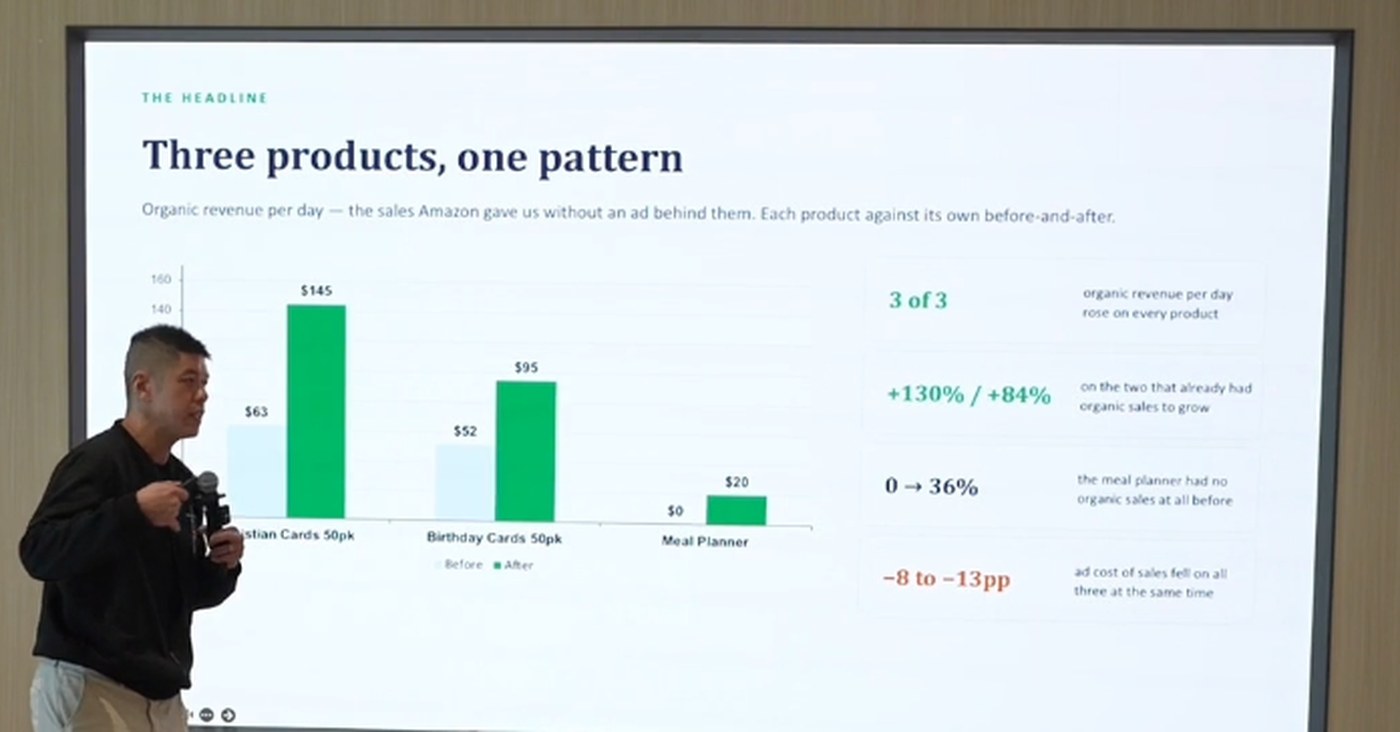
Organic revenue per day rose on all three: by 130% and 84% on the two that already had organic sales, and from nothing to a third of sales on the third. Ad cost of sales fell on every one at the same time.
On one product, conversion went from 12% to 17.7%, ad cost from 20.5% to 7.3%, and daily ad spend from $27 to $13. The idea is fairly straightforward: pay to win the terms you genuinely deserve, then stop paying for them once organic starts carrying more of the demand.
I want to put a sensible caveat around this before we all get carried away. Kevan is a big seller doing a lot of things right, and results like these are never down to a single tool. The Scale Insights MCP is one part of how he works, not the whole story. He found real value in it, and we're simply sharing what he showed us.
But the part that stuck with me wasn't actually the uplift.
On one product, his own negative keywords had quietly been blocking some of his best search terms. There were 230 of them, and 205 were single words, shutting out demand he was actually converting on. Which is a fairly unpleasant thing to discover about your own account, but considerably better than never discovering it.
On another, the problem wasn't the bid at all. It was selling at $5.99 on 31 cents of margin. No amount of clever campaign work fixes maths like that. You can optimise a bad campaign. You cannot optimise your way out of arithmetic.
In his words, the agent's most valuable output wasn't a campaign. It was being shown, with evidence, that he was looking in the wrong place.
That is the bit I find genuinely interesting. Sometimes it finds a keyword worth scaling, sometimes it tells you that you're blocking your own demand, and sometimes it points at something that has nothing to do with advertising at all. An AI agent is useful for doing a lot of the reading, obviously, but it is also useful for making you confront something you might otherwise have happily continued overlooking.
That is why we wanted to share Kevan's workflow. Not because you should copy it exactly; it's his workflow, for his products, built around the way he runs his business. But it's rare to get this clear a look at how a serious operator actually works.
Kevan didn't hand his account to the AI and walk off. He gave it specific jobs, checked what it found, and used the information to make decisions.
I don't often get to watch a customer work like that, let alone sit in a room while they teach us how they think. What an amazing experience and what a wonderful speaker. I promise to share more of these pieces as I collect them.
If you're curious what an agent might turn up in your own account, connect the Scale Insights MCP to Claude or ChatGPT and try it with a problem you’re already working through.